
Description
Bently Nevada 330190‑040‑00‑RU — 3300‑XL ETR Extension Cable (Russian EAC Variant)
Product Overview
The 330190‑040‑00‑RU is an Extended‑Temperature‑Range (ETR) coaxial extension cable for Bently Nevada 3300‑XL 8 mm proximity transducer systems. The suffix ‑RU represents regional variant with EAC conformity documentation for Russian‑Federation import and site acceptance; the electrical and mechanical hardware remains identical to standard 330190‑040‑00‑00. This cable connects proximity probe pigtail to proximitor / 990‑series transmitter, transmitting high‑frequency eddy‑current sensor signals for shaft‑relative vibration, thrust‑position and Keyphasor measurements. ETR insulation allows stable operation in high‑temperature casing‑adjacent environments where standard‑grade cables would degrade prematurely. Compliant with API‑670 turbomachinery protection requirements.
Critical Compatibility Warning
- Exclusively for 3300‑XL 8 mm Microdot‑interface proximity probes and proximitors. Not compatible with NSv / ClickLoc transducer hardware.
- Total transducer system length = probe integral pigtail length + this extension cable length, must strictly match the calibrated length requirement of proximitor / transmitter. Mismatched total length causes scale‑factor drift and measurement inaccuracy.
- Both cable ends are Microdot coaxial connectors. Do not splice, cut or modify factory molded cable assembly.
- The‑RU suffix only provides EAC import documentation; hardware intrinsic‑safety rating follows base‑model specification, verify label before hazardous‑zone installation.
Part Number Decoding
- 330190:3300‑XL ETR high‑temperature extension‑cable series
- ‑040:Nominal cable length = 4.0 meters
- ‑00:Cable construction: non‑armored ETR cable
- ‑RU:Regional variant, supplied with EAC conformity documents for Russian Federation customs clearance and site acceptance
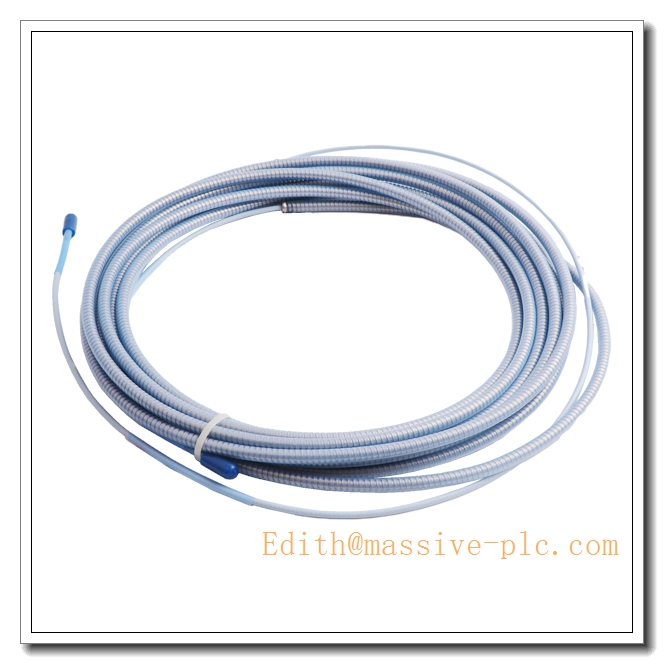
330190-040-00-RU
Key Specifications
| Parameter | Value |
|---|---|
| Part Number | 330190‑040‑00‑RU |
| Series | 3300‑XL ETR Extension Cable |
| Cable Type | Non‑armored high‑temperature ETR coaxial signal cable |
| Nominal Length | 4.0 m |
| Connector Type | Microdot (MS‑type coaxial) at both ends |
| Compatible Transducer | 3300‑XL 8 mm Microdot proximity probe system |
| Insulation Grade | ETR Extended Temperature Range |
| Operating Temperature Range | ‑51 °C ~ +177 °C |
| Minimum Bending Radius | 50 mm (static installation); 100 mm (dynamic vibration environment) |
| Shielding | Double‑layer shield for EMI / RFI noise suppression |
| Certifications | API‑670 compliant; EAC conformity documentation included (‑RU suffix); check hardware label for IS rating |
| Country of Origin | USA |
| Weight | ≈0.22 kg |
Main Features
- ETR extended‑temperature‑range insulation: Resists high casing‑radiated heat, suitable for close‑to‑machine routing where standard cables suffer thermal ageing.
- 4.0‑meter non‑armored Microdot‑to‑Microdot extension cable: Modular building block to configure correct total transducer system length for 3300‑XL 8 mm Microdot systems.
- Double‑shielded coaxial construction: Superior rejection of EMI noise from VFDs, contactors and high‑power AC wiring, preserves eddy‑current signal integrity.
- Factory‑molded Microdot connectors: Consistent impedance, reliable vibration resistance for long‑term turbomachinery service.
- ‑RU regional package: Complete EAC conformity document set for Russian‑based industrial projects, simplifies customs clearance and plant acceptance procedures.
- API‑670 compliant mechanical and electrical performance: Fits standard turbomachinery protection system specifications.
- Modular interoperability within 3300‑XL Microdot transducer family.
Typical Application Scenarios
- Signal extension for 3300‑XL 8 mm Microdot proximity probes on steam turbines, gas turbines, centrifugal compressors in Russian‑site refinery, petrochemical and power‑plant projects
- Cable routing close to hot machine casings, requiring high‑temperature‑resistant ETR grade cable
- Radial shaft‑vibration monitoring, axial thrust‑position measurement and Keyphasor phase‑reference signal transmission
- New‑project construction requiring EAC‑certified monitoring components for Russian‑Federation industrial sites
- Overhaul spare‑part replacement for existing 3300‑XL Microdot‑based transducer loops
- Retrofit of proximity‑monitoring systems where field routing demands high‑temperature‑rated coaxial extension cable
Related & Recommended Alternative Models
| Model | Description |
|---|---|
| 330190‑040‑00‑00 | Standard global‑spec 4 m ETR extension cable, no EAC‑RU documentation |
| 330190‑050‑00‑RU | 5 m non‑armored ETR extension cable,‑RU EAC variant |
| 330190‑080‑00‑RU | 8 m non‑armored ETR extension cable,‑RU EAC variant |
| 330190‑040‑01‑RU | 4 m armored ETR extension cable,‑RU EAC variant |
| 330130‑xx‑12‑00 | Standard‑temperature Microdot extension cables (non‑ETR grade) |
Compatible Components & Accessories
- Proximity probes: 21508‑xx‑xx‑xx‑02 and other 3300‑XL 8 mm Microdot‑interface probes
- Proximitor sensor: 330180‑xx‑00 8 mm proximitor modules
- Monitor system: Bently Nevada 3500 rack system, 3300 series monitors, Microdot‑type 990 transmitters
- Casing‑penetration fitting: 43501‑02‑04‑02 low‑pressure cable‑seal assembly and 43574‑04 grommet accessories
- Installation consumables: Cable clamps, cable glands, high‑temperature cable ties
- Tooling: Specified‑torque Microdot connector tightening tool
Installation and Configuration Guide
Warning: Installation must be completed by qualified instrument technicians. Always refer to original Bently Nevada 3300‑XL transducer‑system manual as primary reference. Verify intrinsic‑safety marking before deployment in explosive classified hazardous zones.
- System Length Calculation Pre‑Check
- Calculate total transducer length = probe integral pigtail length + 4.0 m of this extension cable.
- Confirm total length exactly matches the calibrated‑length requirement of the installed proximitor or transmitter. Length mismatch creates scale‑factor error.
- Cable Routing Requirements
- Route ETR coaxial cable separately from high‑power AC, VFD and contactor cables to minimize EMI interference.
- Maintain minimum static bending radius ≥50 mm; avoid sharp kinks. Do not pull cable by connectors.
- Where cable passes through machine‑case wall, use approved cable‑seal assembly (43501‑02‑04‑02). Prevent mechanical crush and abrasion damage to outer insulation.
- Connector Mating Procedure
- Clean Microdot connector contact surfaces before connection. Align pin‑keyway correctly, tighten to manufacturer‑specified torque value. Never force connector engagement.
- Provide cable strain‑relief via clamps; avoid mechanical tension transferred directly to Microdot connectors.
- System Commissioning
- Complete full transducer loop assembly, power‑up proximitor / monitor hardware.
- Read static gap voltage to confirm probe gap setting. Perform static‑gap calibration test with 8 mm calibration fixture to validate system scale‑factor.
- Confirm Not‑OK fault status clears after proper wiring and gap adjustment.
- Maintenance & Troubleshooting
- During machinery turnaround, inspect Microdot connectors for oil contamination, dirt and corrosion. Check ETR insulation for heat‑caused hardening or cracking.
- Unstable gap‑voltage readings, high noise level or persistent Not‑OK faults may indicate damaged cable, bad connector contact or incorrect total‑system cable length.
- If cable is damaged, replace the complete factory cable assembly; field splicing or repairing coaxial cable is prohibited.
- Regional Documentation Note
- Model 330190‑040‑00‑RU is supplied with EAC conformity documentation for Russian‑Federation import and site acceptance. Electrical‑mechanical specifications are identical to base‑model 330190‑040‑00‑00.
Supplementary Remark
330190‑040‑00‑RU is a 4‑meter non‑armored ETR high‑temperature Microdot‑to‑Microdot extension cable for 3300‑XL 8 mm proximity‑transducer systems,‑RU suffix delivers EAC conformity documents for Russian‑market projects. It is incompatible with NSv / ClickLoc transducer hardware. Before commissioning, cross‑check total transducer‑system length, connector type, temperature rating and EAC‑RU documentation requirement against project BOM and mechanical drawings.


 Start Chat