Description
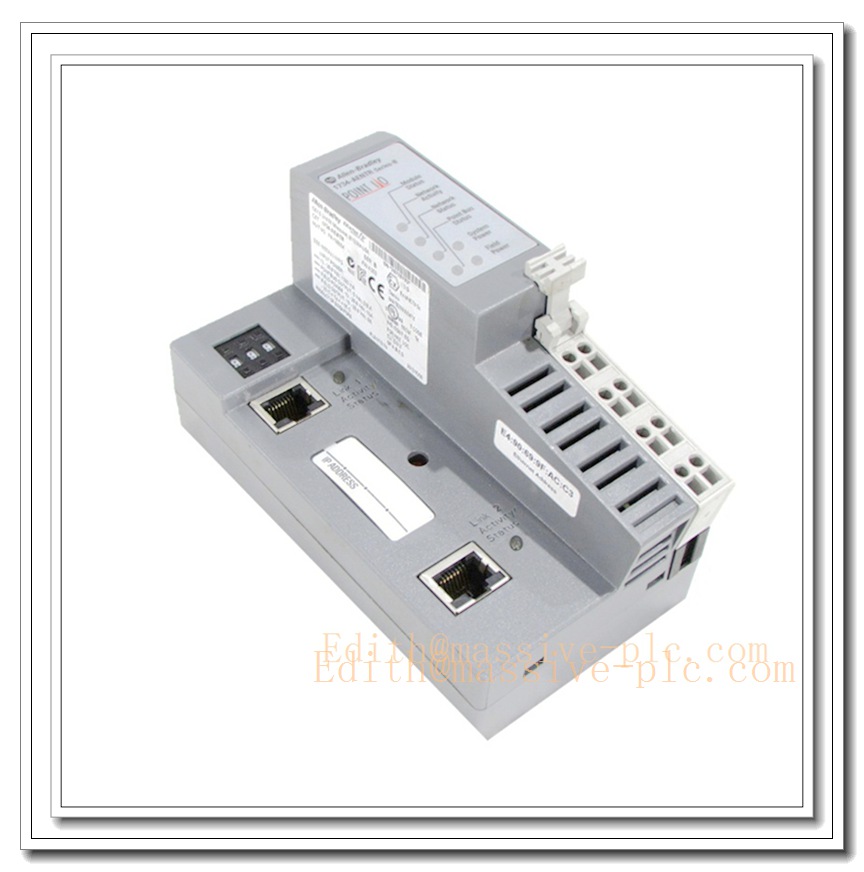
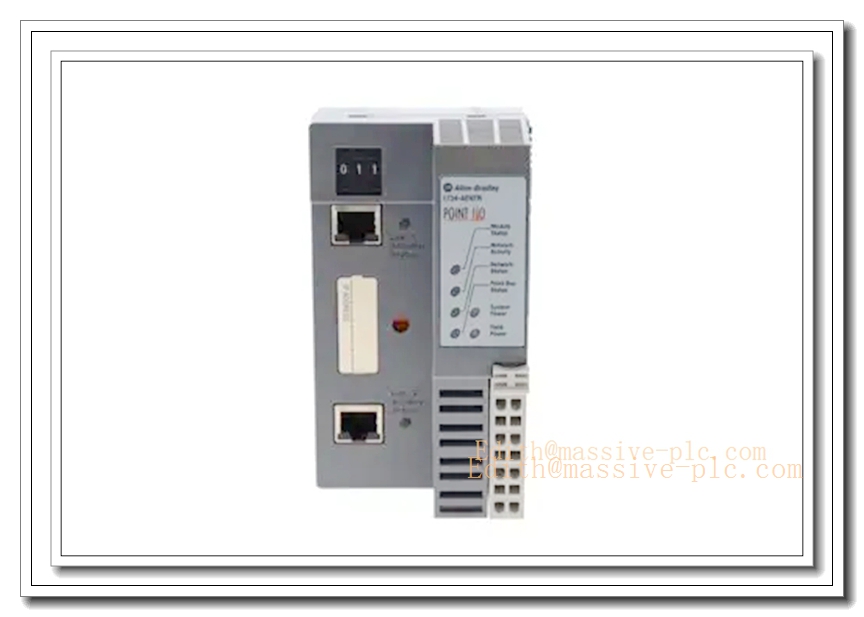
Allen‑Bradley 1734‑AENT Point I/O Ethernet/IP Adapter Module
Meta Description
Original Allen‑Bradley 1734‑AENT Ethernet/IP adapter for Point I/O distributed I/O system, reliable stock, fast quotation support. We operate 86 shared warehouses globally, so it may take several hours to deliver an accurate quotation; thank you for your understanding, and we will handle your inquiry promptly.
1734-AENT
Product Brief Introduction
The 1734‑AENT is an Ethernet/IP communication adapter designed for the Allen‑Bradley Point I/O distributed I/O platform. It serves as the network gateway that links Point I/O modules to an Ethernet/IP control network, enabling seamless real‑time data exchange between I/O devices, PLCs, HMIs and other automation controllers. Compact, hot‑swappable and easy to deploy, this adapter is widely adopted for decentralized automation, skid‑mounted machinery, process control and retrofit projects. We operate 86 shared warehouses globally, so it may take several hours to deliver an accurate quotation; thank you for your understanding, and we will handle your inquiry promptly.
Main Technical Specifications
- Part Number: 1734‑AENT
- Manufacturer: Allen‑Bradley (Rockwell Automation)
- Protocol: Ethernet/IP
- Supported Backplane: Point I/O (1734 series)
- Network Ports: Dual Ethernet ports (daisy‑chain support)
- Communication Rate: 10/100 Mbps auto‑negotiation
- Module Capacity: Supports up to 63 Point I/O modules on one backplane
- Operating Voltage: 24 VDC
- Hot Swap: Supported
- Enclosure Rating: IP20 (for backplane mounting)
- Operating Temperature: 0 °C to +60 °C
- Storage Temperature: −40 °C to +85 °C
- Shock & Vibration: Compliant with Rockwell industrial standard for factory automation
- Certifications: CE, UL, cULus, C‑Tick
- Mounting: DIN rail
Quality Control Procedure
Every 1734‑AENT unit goes through our standardized multi‑stage QC workflow before dispatch. First, incoming visual inspection verifies label integrity, casing condition and original part marking. Functional testing covers Ethernet link handshake, Ethernet/IP connection establishment, backplane communication and cyclic data transmission under load. Continuous burn‑in runs for a defined period to eliminate early failure risks. After testing, units are cleaned, packed with anti‑static shielding and labelled with traceability information. All test records are retained for traceability. If you request a quotation, please note that we operate 86 shared warehouses globally, so it may take several hours to deliver an accurate quotation; thank you for your understanding, and we will handle your inquiry promptly.
FAQ
Q: What is the function of 1734‑AENT? A: It is an Ethernet/IP adapter that connects a Point I/O backplane to an Ethernet/IP network, allowing a controller to read and write distributed I/O data.
Q: Can it be hot‑swapped? A: Yes, the 1734‑AENT supports hot swapping when installed following official Rockwell guidelines.
Q: How many I/O modules can one 1734‑AENT drive? A: It supports up to 63 Point I/O modules on a single local backplane.
Q: Does it support daisy‑chaining? A: Yes, the dual Ethernet ports support linear daisy‑chain topology to reduce switch requirements.
Q: Is this an original Rockwell part? A: We supply original Allen‑Bradley 1734‑AENT subject to stock availability.
Q: How long will I receive my quote? A: We operate 86 shared warehouses globally, so it may take several hours to deliver an accurate quotation; thank you for your understanding, and we will handle your inquiry promptly.
Installation & Configuration Guide
Mount the 1734‑AENT onto a standard DIN rail and assemble Point I/O modules sequentially on the backplane. Supply regulated 24 VDC power and verify correct polarity before powering on. Connect Ethernet cables to the ports; choose either star or daisy‑chain topology. Use Rockwell Studio 5000 / RSLogix 5000 to add the adapter to the I/O tree, assign an IP address via BOOTP/DHCP or static configuration, and configure RPI (Requested Packet Interval) for cyclic data. Download the project to the controller, establish the Ethernet/IP connection, and validate input and output signals. Always follow Rockwell’s official installation manual and local electrical codes; isolate power before adding or removing modules unless performing approved hot swap.
Relevant News & Events
Ethernet/IP distributed I/O continues to dominate modular automation for packaging, material handling, water treatment and oil & gas auxiliary skids. The Point I/O family remains one of Rockwell’s most widely deployed decentralized I/O lines, favoured for small footprint and flexible expansion. System integrators frequently select the 1734‑AENT when upgrading legacy discrete I/O into Ethernet‑based control architectures, as it preserves existing Point I/O wiring while bringing devices onto modern EtherNet/IP networks. Supply volatility for Rockwell automation components has pushed global buyers to seek reliable multi‑warehouse suppliers with verified original stock.
Application Scenarios & Functional Advantages
Typical Use Cases
- Packaging machinery and conveyor lines
- Water and wastewater treatment skids
- Material handling and warehouse automation
- Petrochemical auxiliary control packages
- Food & beverage process skids
- Machine retrofit and migration projects
- Building utilities and HVAC distributed control
Key Advantages
- Compact form factor saves cabinet space
- Dual‑port Ethernet for flexible network topology
- Stable real‑time cyclic I/O over Ethernet/IP
- Hot swap minimizes downtime during maintenance
- Broad compatibility across the full 1734 Point I/O series
- Easy integration with Logix family controllers
- Proven long‑term reliability in harsh factory environments
- Simplifies expansion of remote I/O clusters without heavy wiring
Recommended Related Part Numbers
- 1734‑IB8: 8‑point digital input module
- 1734‑OB8: 8‑point digital output module
- 1734‑IE2V: 2‑channel analog voltage input
- 1734‑OE2V: 2‑channel analog voltage output
- 1734‑RTB: Removable terminal blocks
- 1734‑TB: Terminal base units
- 1734‑AENTR: Redundant Ethernet/IP adapter variant