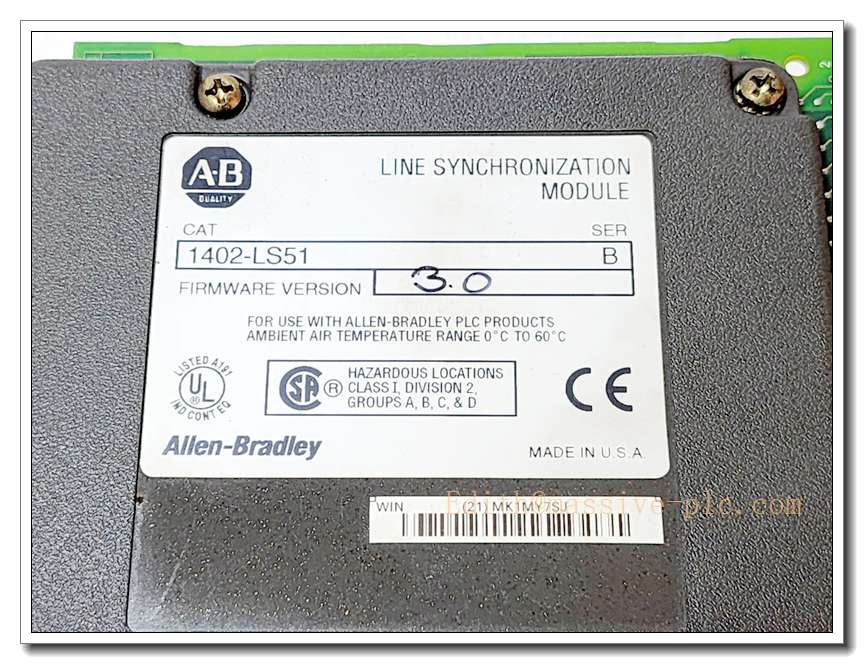
Description
1402-LS51 is a high-precision solid-state Line Synchronization Module (LSM) manufactured by Allen-Bradley (a core brand under Rockwell Automation), belonging to the Bulletin 1402 power monitoring and protection product series. Designed exclusively for three-phase power distribution systems, it serves as the core synchronization control unit to execute precise phase, voltage, and frequency matching across dual independent three-phase power grids, ensuring seamless and non-disturbing grid switching or parallel operation. It integrates advanced solid-state circuit design, strong electrical noise and vibration resistance, and SIL-rated safety performance, delivering exceptional stability and reliability for critical power management scenarios. Widely deployed in industrial power plants, large manufacturing facilities, and data center power supply systems, it is a critical maintenance spare part for legacy Allen-Bradley 1771 I/O platform systems, with current market prices ranging from US1800toUS4500 per unit.
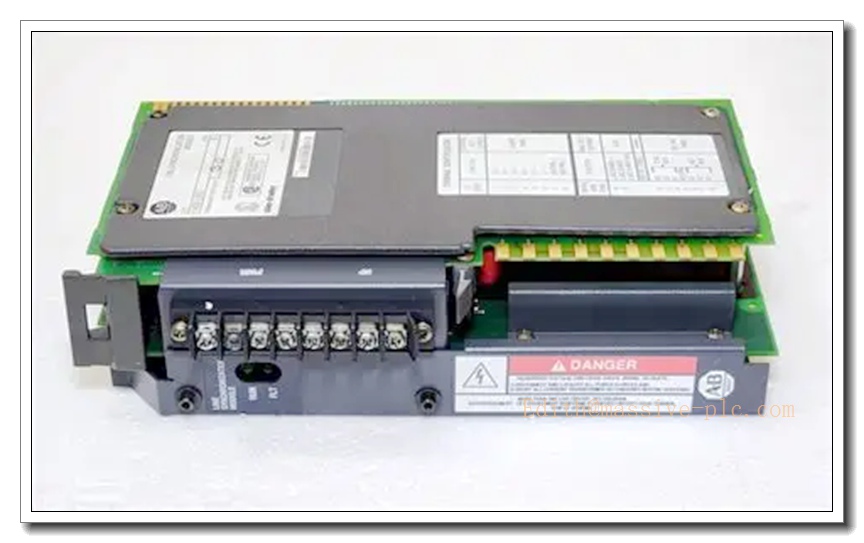
1402-LS51
Core Technical Specifications
| Parameter | Details |
|---|---|
| Manufacturer | Allen-Bradley (Rockwell Automation) |
| Part Number | 1402-LS51 |
| Product Type | Line Synchronization Module (Bulletin 1402 LSM) |
| Platform Compatibility | Standard 1771 I/O Chassis, occupies 2 slots |
| Input Voltage (Power Grid) | 100/120 VAC, 3-Phase |
| Internal Control Supply | 4 VDC / 5 VDC dual compatible |
| Continuous Current Measurement Range | 0-5 A RMS |
| Short-Term Peak Current Capability | 200 A RMS for 1 second |
| Operating Frequency Range | 40-100 Hz |
| Frequency Resolution | 0.01 Hz |
| Voltage Match Error Resolution | 0.05% steps |
| Phase Match Error Resolution | 1 degree |
| Voltage Input Impedance | 728 kOhm |
| Voltage Burden | 0.02 V |
| Backplane Current Draw | 1.1 A |
| Nominal Output Frequency | 65 Hz |
| Maximum Output Power Support | 0-400 kW |
| Product Weight | 3.35 kg (7.39 lbs) |
| Dimensions | 254 × 53.94 × 148.08 mm |
| Product Lifecycle Status | Discontinued / Obsolete (New original and refurbished stock widely available in the market) |
| Standard Warranty | 12 months manufacturer defect warranty |
Key Features & Advantages
- Ultra-High Precision Synchronization Performance: It achieves 0.01Hz frequency resolution, 0.05% voltage matching accuracy, and 1-degree phase matching precision, ensuring zero-impact seamless parallel operation or switching between dual three-phase power grids, completely avoiding power grid impact and equipment damage caused by synchronization errors.
- Robust Industrial Durability: The full solid-state circuit design has no mechanical moving parts, with excellent resistance to electrical noise and vibration, adapting to harsh industrial power plant environments with strong electromagnetic interference and frequent mechanical vibration.
- High Overload Resistance Capability: It can withstand 200A RMS peak current for 1 second, effectively resisting instantaneous surge current shocks during power grid switching, ensuring the safety of the module and rear-stage power distribution equipment.
- Seamless System Compatibility: It can be directly plugged into the standard Allen-Bradley 1771 I/O chassis, no additional adapter modules are required, perfectly integrating into legacy 1771 platform automation control systems, greatly reducing system transformation and maintenance costs.
- SIL-Rated Safety Performance: It meets industrial safety standards for solid-state control equipment, with built-in multi-level fault self-diagnosis functions, which can quickly identify abnormal conditions such as power grid frequency drift, voltage fluctuation, and phase deviation, and output alarm signals in time.
- Compact Space-Saving Design: The dual-slot installation form factor makes full use of the limited space inside the 1771 I/O chassis, no additional independent installation cabinet is required, greatly reducing the occupation of control room space.
Typical Application Scenarios
The 1402-LS51 is widely deployed in industrial scenarios that require high-reliability power grid synchronization control:
- Industrial Power Plants: Synchronization control for grid-connected operation of generator sets and the public power grid, ensuring no-impact grid connection of large generators.
- Large Manufacturing Facilities: Dual-power grid seamless switching control for heavy industrial production lines, preventing production line shutdown losses caused by power grid switching.
- Data Center Power Systems: Synchronization control between UPS backup power supply and the main power grid, ensuring uninterrupted power supply for critical IT equipment.
- Metallurgy & Heavy Industry: Dual-power grid parallel operation control for large metallurgical equipment, ensuring the stable operation of high-power heavy industrial equipment.
- Legacy System Retrofit: As an original spare part for aging Allen-Bradley 1771 I/O platform systems, it restores the original full power grid synchronization function of old equipment without replacing the entire power management system, saving significant retrofit costs.
Installation & Maintenance Guidelines
- Before installation, confirm that the target 1771 I/O chassis model is within the compatible range, and strictly follow ESD anti-static operation specifications to avoid electrostatic damage to precision electronic components on the board.
- After installation, check that all three-phase power grid signal input terminals and backplane connection terminals are securely connected, and the tightening torque meets the standard requirements to prevent signal loss or synchronization misoperation caused by poor contact.
- Regularly check the operating status of the module through the upper power management system, and clean the dust accumulated on the surface of the module quarterly to maintain good heat dissipation performance.
- Keep the internal ventilation of the control cabinet unobstructed to ensure that the heat generated during long-term operation can be dissipated in time, extending the service life of the module.
- For critical power supply systems, it is recommended to prepare spare units in advance to avoid long-term power supply interruption losses caused by unexpected failures.