Description
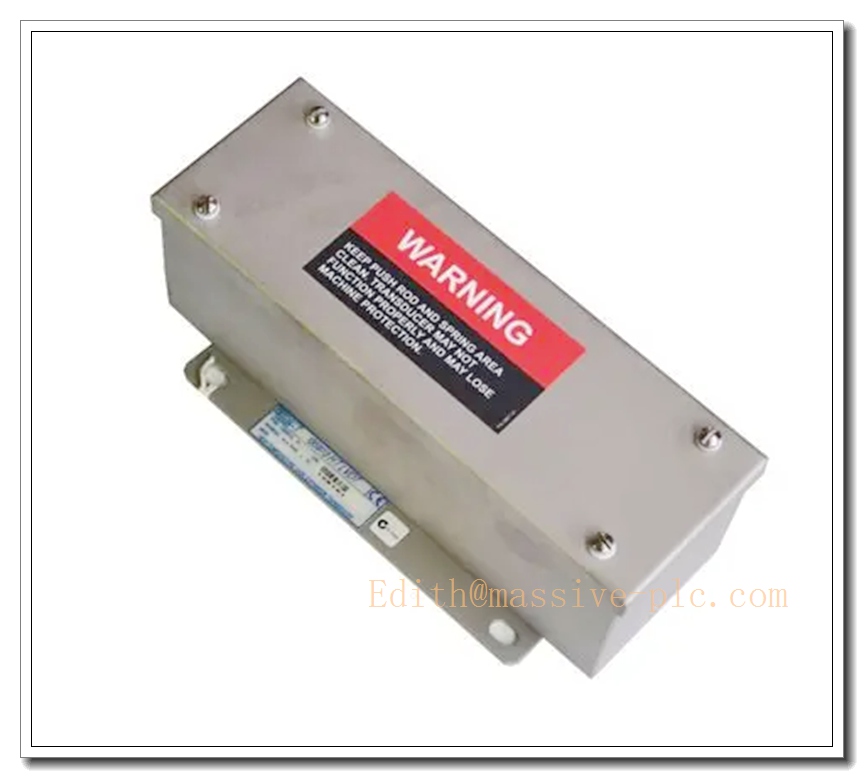
135613-02 is a high-precision High Temperature Case Expansion Transducer Assembly manufactured by Bently Nevada, a leading global brand under Rockwell Automation in the field of turbomachinery condition monitoring. Designed exclusively for large industrial steam turbines and heavy rotating equipment, it uses an LVDT (Linear Variable Differential Transformer) sensing element to accurately measure the relative thermal expansion displacement between the turbine casing and its foundation during equipment startup, steady-state operation, and load changes. It provides continuous, high-accuracy displacement feedback for Bently Nevada 3300 and 3500 series TSI (Turbine Supervisory Instrumentation) systems, enabling real-time monitoring of casing thermal growth to prevent mechanical stress damage caused by uneven thermal expansion. Widely deployed in thermal power, petrochemical, and metallurgical heavy-duty industrial scenarios, it is a critical maintenance spare part for aging Bently Nevada turbine monitoring systems.
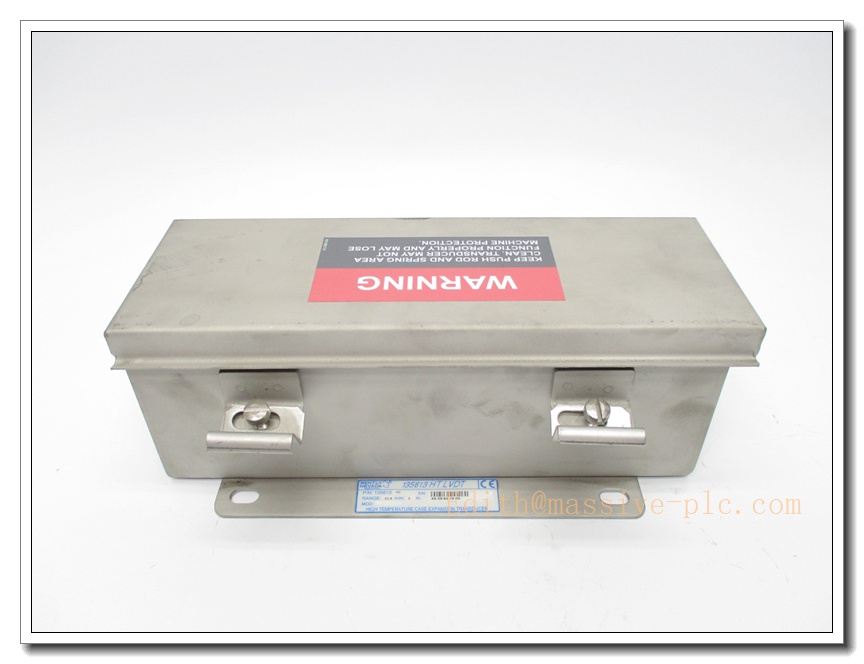
135613-02
Core Technical Specifications
| Parameter | Details |
|---|---|
| Manufacturer | Bently Nevada (Rockwell Automation) |
| Part Number | 135613-02 |
| Product Type | High Temperature Case Expansion Transducer Assembly |
| Sensing Principle | LVDT (Linear Variable Differential Transformer) |
| Linear Measurement Range | 50.8 mm (2.00 in) |
| Rod Length | 152.4 mm (6.00 in) |
| Spring Return Configuration | No spring return (00 option) |
| Electrical Scaling Factor | 0.10 V/mm (2.5 V/in) |
| -3dB Frequency Response | 200 Hz (typical) |
| Nonlinearity | ≤ 0.25% of full scale |
| Long-Term Stability | 0.125% of full scale |
| Temperature Coefficient | Max 0.05% / °C (0.028% / °F) |
| Operating Temperature Range | -25°C to +85°C (-13°F to +185°F) |
| Storage Temperature Range | -55°C to +125°C (-67°F to +257°F) |
| Dimensions (H×W×D) | 8.89 cm × 11.7 cm × 24.1 cm |
| Compatible Monitoring Systems | Bently Nevada 3300, 3500 Series TSI Platforms |
| Product Lifecycle Status | Discontinued / Obsolete (New original and refurbished stock widely available in the market) |
Key Features & Advantages
- Ultra-High Measurement Precision: The high-performance LVDT sensing element achieves nonlinearity ≤ 0.25% of full scale and long-term stability up to 0.125% of full scale, accurately capturing tiny thermal expansion displacements of the turbine casing, providing reliable data support for equipment thermal stress assessment.
- Excellent High-Temperature Adaptability: The dedicated high-temperature resistant design supports continuous stable operation in the -25°C to +85°C wide temperature range, with an extremely low temperature coefficient of 0.05% / °C, ensuring measurement accuracy is not affected by drastic temperature changes during turbine startup and shutdown.
- Robust Industrial Durability: The integrated protective shield structure effectively isolates dust, oil mist, and high-temperature airflow interference from the industrial site, protecting the internal precision sensing components and extending the service life of the transducer in harsh turbine workshop environments.
- Wide System Compatibility: Natively compatible with Bently Nevada 3300 and 3500 series TSI systems, no additional signal conversion modules are required, and it can be directly connected to the monitoring system to output standard displacement signals, greatly reducing on-site installation and debugging time.
- No Spring Return Design: The non-spring return configuration is specially optimized for long-term fixed installation scenarios of turbine casing monitoring, avoiding measurement drift caused by spring fatigue after long-term operation, and ensuring the long-term reliability of measurement data.
Typical Application Scenarios
The 135613-02 is widely deployed in industrial scenarios that require high-precision turbine casing thermal expansion monitoring:
- Thermal Power Industry: Thermal expansion displacement monitoring for large steam turbine casings in thermal power plants, preventing equipment damage caused by uneven thermal expansion during startup and load changes.
- Petrochemical Industry: Case expansion monitoring for industrial steam turbines and large centrifugal compressors in oil refineries and chemical plants, ensuring the stable operation of core power equipment.
- Metallurgy & Heavy Industry: Thermal growth monitoring for large steam turbine drives in metallurgical plants, avoiding mechanical jamming and stress damage of heavy rotating equipment.
- Legacy System Retrofit: As an original spare part for aging Bently Nevada 3300/3500 series TSI systems, it restores the original high-precision casing expansion monitoring function of old equipment without replacing the entire monitoring system, saving significant retrofit costs.
Installation & Maintenance Guidelines
- Before installation, confirm that the installation position on the turbine casing and foundation meets the design requirements, and ensure that the transducer measuring rod is kept parallel to the direction of casing thermal expansion to avoid measurement errors caused by installation misalignment.
- After installation, perform full-stroke calibration with a standard displacement gauge to confirm that the output signal fully matches the actual displacement, ensuring the measurement accuracy meets the system requirements.
- Regularly check the mechanical connection between the transducer and the measured point to prevent signal drift caused by loose fixing bolts.
- Keep the surface of the transducer clean, and regularly remove accumulated dust and oil mist to avoid affecting the normal movement of the internal LVDT components.
- If the monitoring system reports abnormal displacement data, the 135613-02 transducer and its mechanical connection structure should be inspected first.